Every data engineer eventually joins two datasets on a name. A customer list against a vendor file. A court record against a company registry. It works in the demo, and then it quietly attaches records to the wrong entity.
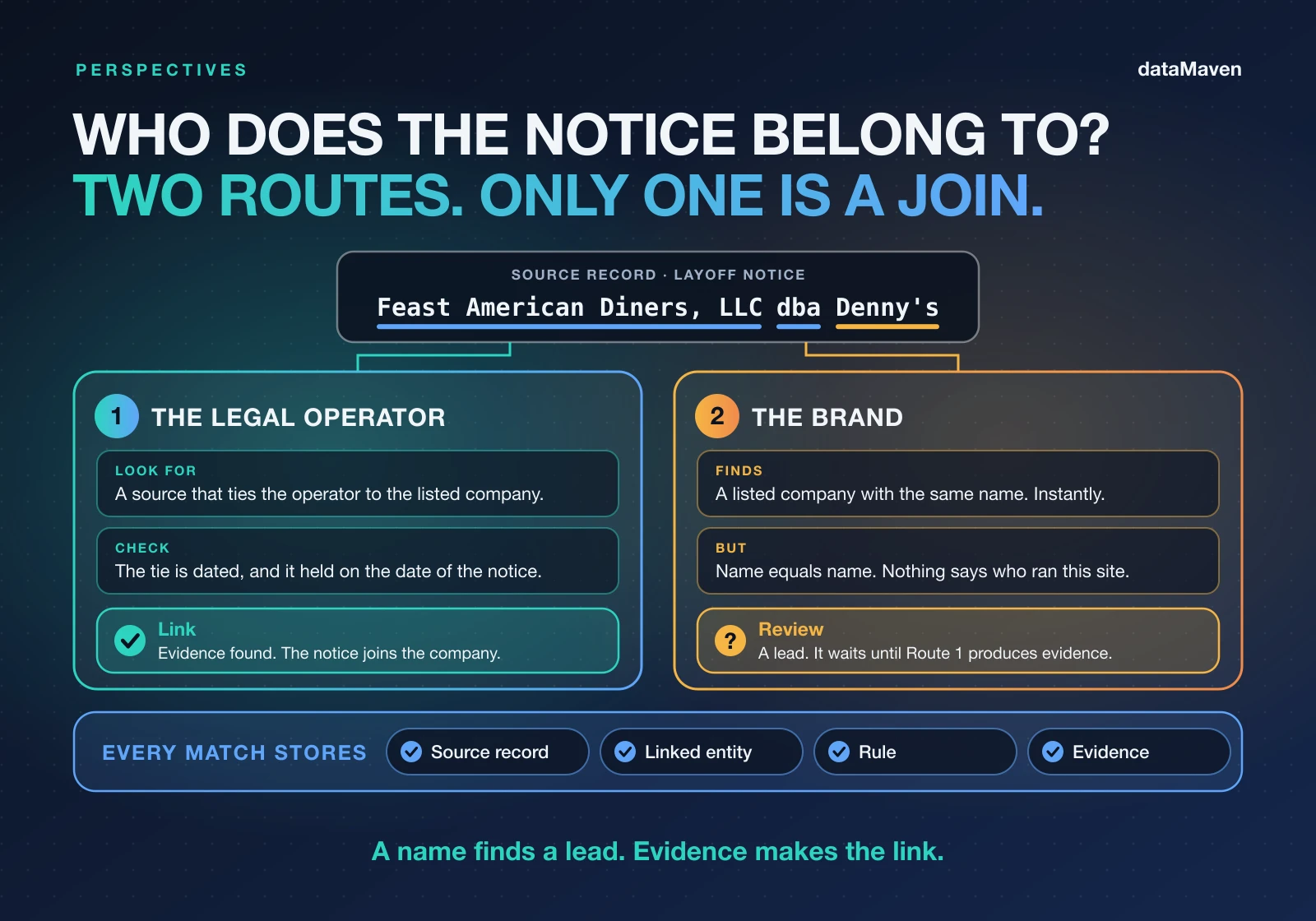
Here is a small example from public records. A state publishes a layoff notice. The employer is listed as Feast American Diners, LLC dba Denny’s. Search a company database and Denny’s comes right up. Should the notice be joined to that company?
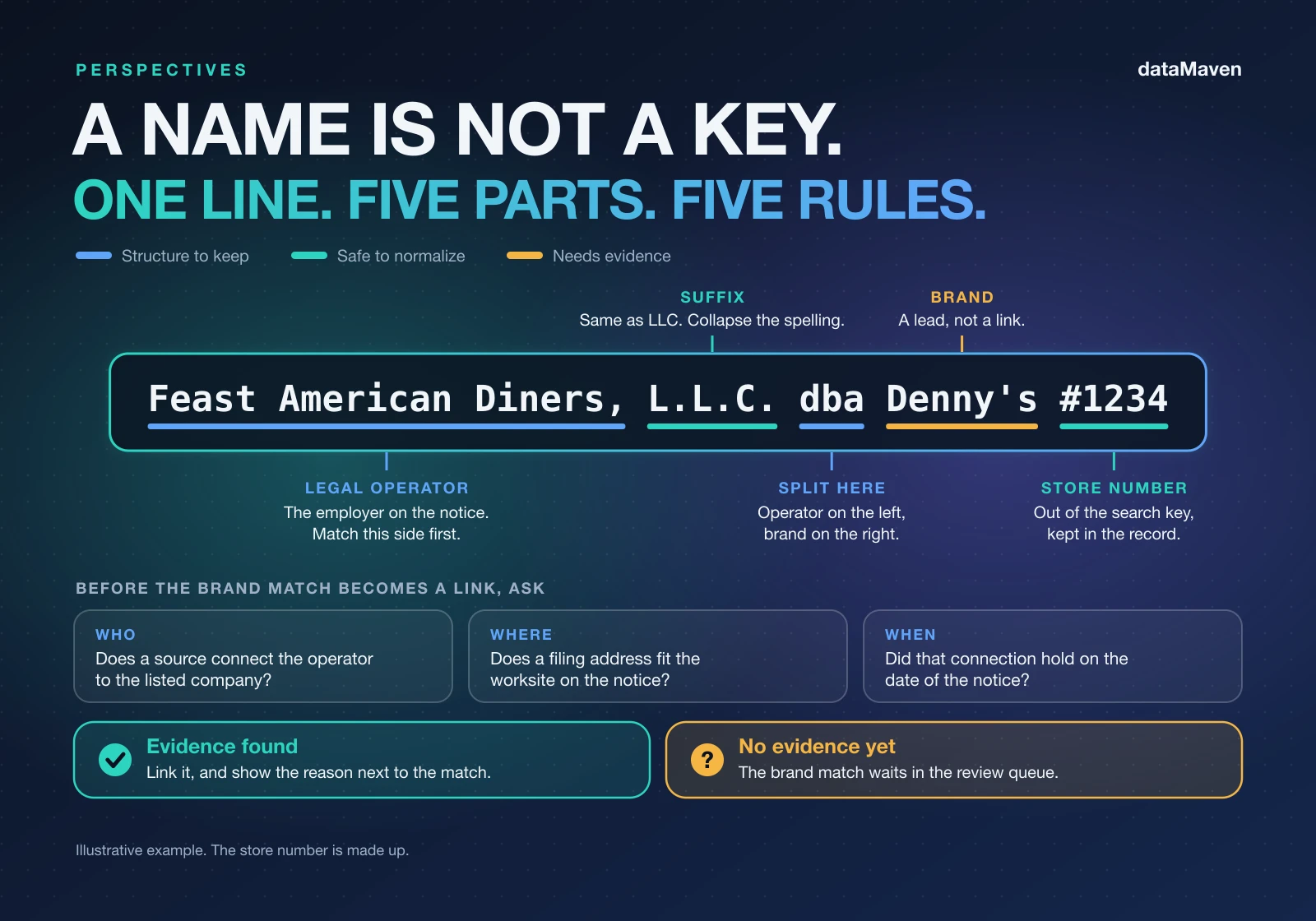
The string contains two names. The left side of dba is the legal operator. The right side is the brand it does business under. The brand match is a lead. To make it a join, you need a source that connects the operator to the listed company on the date of the notice. Without that, the record goes to review.
The rest of this post is the set of rules I’d apply to any name-based join.
Normalize the spelling. Keep the structure.
Some differences are safe to collapse. L.L.C. and LLC are two spellings of the same suffix. HMS Host and HMSHost can share a search key. A store number can come out of the lookup key while staying in the original record.
That last point generalizes. Build the match key as a derived column and never overwrite the raw value. You will change your normalization rules, and you’ll want to re-derive.
Other edits change meaning and require evidence. Take Acme Widgets Rochester. If the record places the worksite in Rochester, the matcher can try Acme Widgets and run it through the usual checks. Put the same string on a Buffalo record and the shorter name stays a candidate. A second field tells you whether Rochester is a location label or part of the name.
An alias has a scope
A name index can hold legal names, former names, names from pension filings, and subsidiary names disclosed in SEC filings. Treat each entry as a claim with a scope: who held this name, where, and when. Each entry carries whatever dates and places its source supports. A name that was valid in 2015 is not evidence for a 2024 record.
Hard identifiers can extend the index. A tax ID can connect an additional filing name to an entity.
Don’t let a guess become evidence
A join based on a name alone shouldn’t create a new alias.
This is the feedback loop that degrades matching systems over time. Inferred links get written back into the reference data, and the next run treats them as facts. Keep asserted aliases and inferred matches in separate places, and only let the first kind feed the matcher.
Use an independent attribute as a guardrail
Geography helps break ties. If two private employers share a name, a filing address in the same city as the record can make one a better candidate.
A second, unrelated attribute can overturn that result. One rule I like compares the layoff notice to the candidate’s own pension plans. Say the notice names 400 workers and the candidate’s plans report 150 participants. That is fewer than half, so the city-based match is blocked. A small local namesake can have the right name and the right address and still be the wrong entity.
The general pattern is a plausibility check on something the name can’t tell you: size, industry, active dates.
More sources can create more ambiguity
Adding a dataset feels like adding signal. It also adds identities. Imagine adding federal contracting records to a database that already holds SEC filings and pension returns. Acme Widgets Inc. is in the index under the identifier from its SEC filings. The contracting data adds Acme Widgets under a federal contractor ID. If no source connects those identifiers, counting both entries as independent, equally strong claims can turn yesterday’s clear match into today’s tie.
One way to handle that is to keep the contractor-only entry available for review when no stronger claimant holds the name. Both source identities stay intact until there’s evidence to merge them. This is where provenance earns its keep. The matcher needs to know how each name entered the index before it can decide how much weight to give it.
Show the evidence behind the join
A wrong join is hard to spot because both sides are real. Put a layoff notice on the wrong company’s timeline and it can appear to corroborate a restructuring filing. A reader can click through to two genuine documents and still come away with a false story.
So store a reason with every match: the source record, the entity it was linked to, and the rule and evidence that justified the link. Treat the review queue as a normal output of the pipeline. For the Denny’s example, the decisive evidence would be a dated record tying the legal operator to the listed company. Until that turns up, review is exactly where the brand match belongs.