“Modernize the data architecture” almost always gets budgeted as a migration. A new lakehouse. A new cloud. A new catalog, a new orchestrator, a new governance tool. Eighteen months later the logos on the slide are different — and the problems are word-for-word the same.
That sentence trips people up, because we’ve been trained to treat modern tools and modern architecture as the same thing. They aren’t. Modernization is a property of how a system is structured — not what it’s built on.
What actually changed in 2026
The cloud-versus-on-prem, warehouse-versus-lakehouse arguments are over. Everyone can get the modern stack now; it’s a purchase order, not an advantage. So tools stopped being the thing that separates a modern data organization from a stuck one.
Two things did change the stakes:
- AI made architectural debt expensive and visible. Point AI at fragmented, ungoverned, inconsistent data and it amplifies the mess — at scale, with confidence. Debt you could live with for a decade is now a blocker on the thing your board is asking for.
- Cost pressure caught up with sprawl. The pile of half-used platforms and overlapping pipelines that was tolerable in a growth market is now a line item somebody’s told to cut.
So in 2026 the reason to modernize isn’t “get to the cloud.” It’s that change has become constant — AI, regulation, cost, consolidation — and most enterprise architectures can’t absorb change without a project every time.
What modernization actually is
The real markers of a modern data architecture have nothing to do with which vendor is on the invoice:
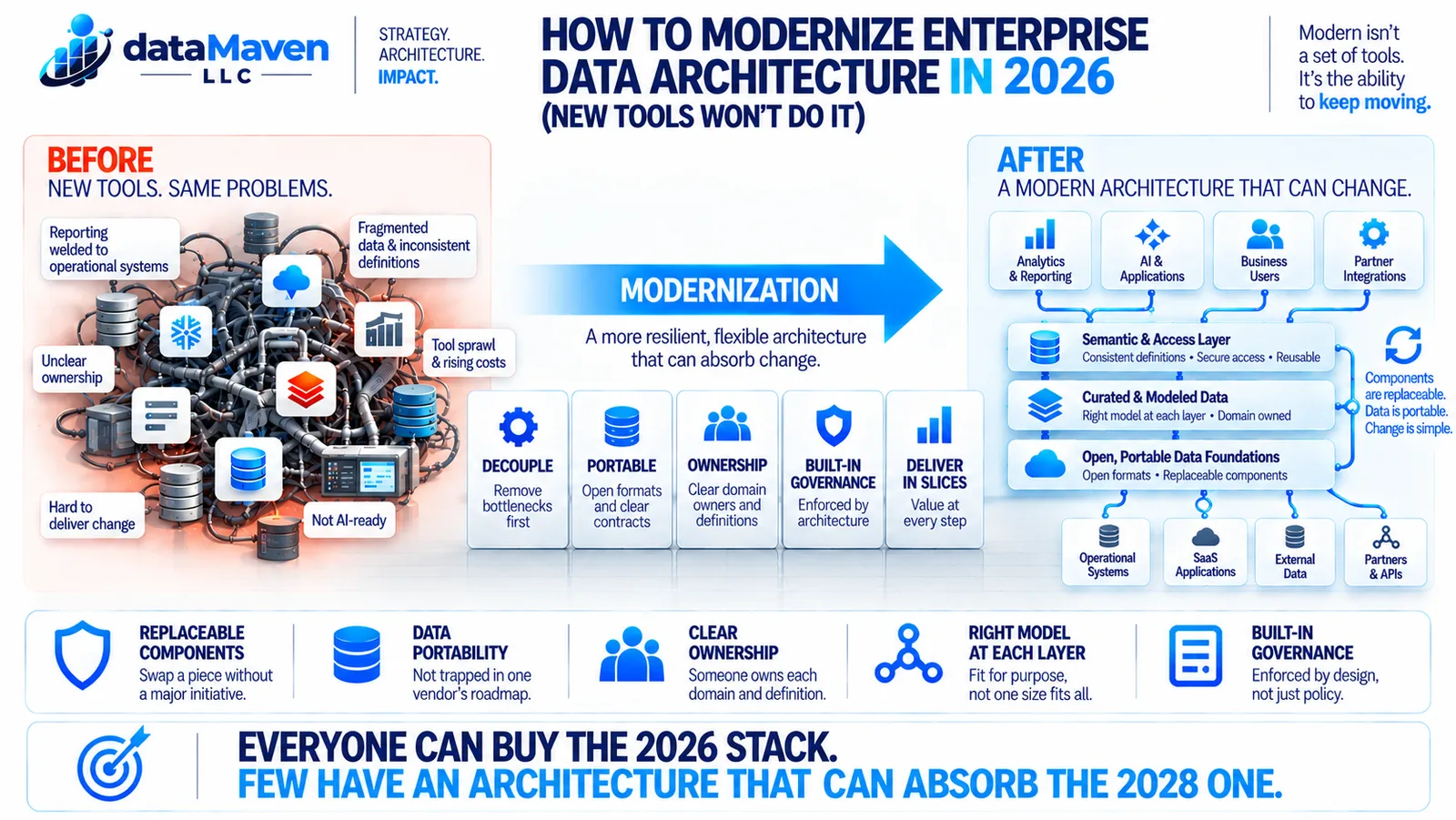
- Components are replaceable — you can swap a piece without a nine-month initiative
- Data is portable — not trapped in one platform’s format or one vendor’s roadmap
- Ownership is clear — someone owns each domain, its definitions, and its source of truth
- The right model lives at each layer — not one modeling philosophy forced across all of them
- Governance is built in, not bolted on — enforced by the architecture, not a policy
None of that is a product you can buy. All of it survives your next migration.
The migration trap
The most expensive way to “modernize” is the big-bang re-platform: freeze the roadmap, move everything, arrive eighteen months later with the same coupling on newer infrastructure — plus the migration bill and a team that’s spent.
Lift-and-shift relocates your problems; it doesn’t solve them. If the old warehouse was a tangle, the new lakehouse will be one too — because the tangle was in the design, not the engine. The architecture around the database has always mattered more than the database.
How to actually do it
Modernization is a sequence you steer, not a destination you buy. Where I’d start:
- Decouple what’s blocking change first. Usually that’s reporting welded to operational systems, and the one integration everyone’s afraid to touch. Free those and the whole thing starts to move.
- Get portable at the boundaries. You don’t need to be multi-cloud; you need to not be trapped. Own your data in open formats with explicit contracts, so the next migration is a config change, not a rewrite.
- Fix ownership before tooling. A new catalog on top of unclear ownership just documents the confusion faster.
- Ship modernization in slices. Each step should pay off on its own — a decoupled reporting layer, a domain with a clean contract — not a two-year program that only delivers at the very end.
- Let AI-readiness set the bar, not the agenda. You’re not modernizing for AI. But “could AI actually trust this data?” is a sharp test of whether the foundation is sound.
Final thought
The companies that look modern in 2028 won’t be the ones that bought the 2026 stack. Everyone bought the 2026 stack. They’ll be the ones whose architecture can absorb the 2028 one without another re-platform.