
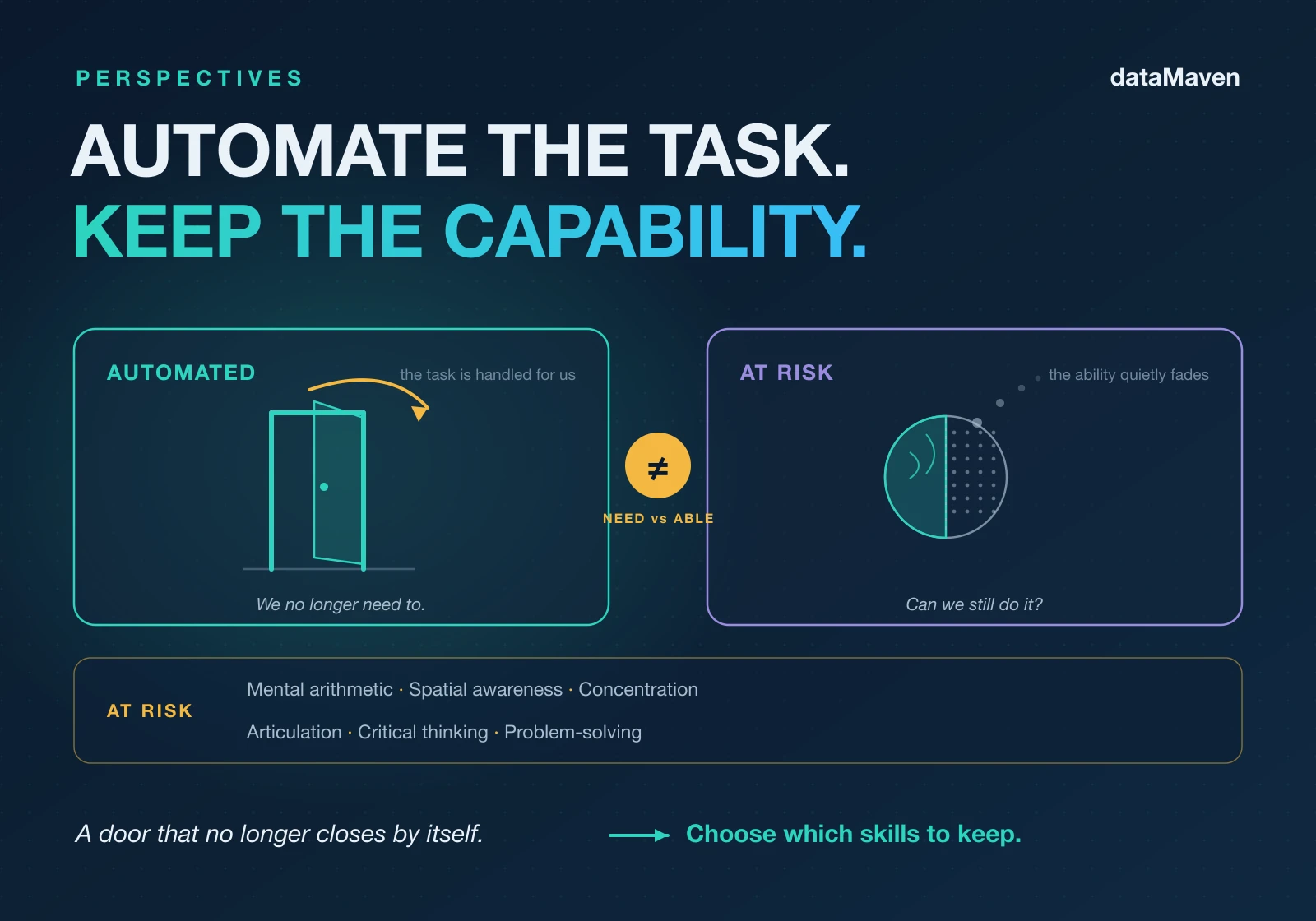
There’s a small coffee house in my neighborhood with one quirk: the front door doesn’t close by itself.
On a warm day, nobody notices. On a cold one, everyone in the room feels it — so I got into the habit of closing it behind the people who didn’t.
Eventually curiosity got the better of me, and I started keeping track. Over two months and about fifty people, a pattern showed up: younger visitors tended to leave the door open; older ones closed it without thinking.
Not a rigorous study. But an interesting one.
Younger generations grew up with doors that close themselves. For older ones, closing a door was a deliberate act that hardened into instinct.
I’m on the wrong side of that line myself. I still reach to close the trunk of a rideshare by hand — and occasionally get a shout from a driver whose car would have done it for me.
Both behaviors are conditioned by the technology we grew up with.
The bigger question
As automation, AI, sensors, and autonomous systems spread, which skills and cognitive abilities are next?
- Mental arithmetic, when every device can calculate for us?
- Spatial awareness, when navigation tells us where to turn?
- Concentration, when technology is built to fragment our attention?
- Articulating our thoughts, when AI can write for us?
- Critical thinking, when answers arrive faster than we can form the question?
- Problem-solving, when we hand off the search for the solution?
Technology has always made some skills obsolete while opening room for new ones. What’s different now is the speed of the change — and the nature of what we’re handing over.
We’re no longer automating only physical labor and repetitive tasks. We’re automating cognition.
Maybe the real question of progress isn’t what we can automate. It’s which human capabilities we consciously choose to keep — even when technology makes them look redundant.
All of that, from a coffee house with a door that doesn’t close by itself.