
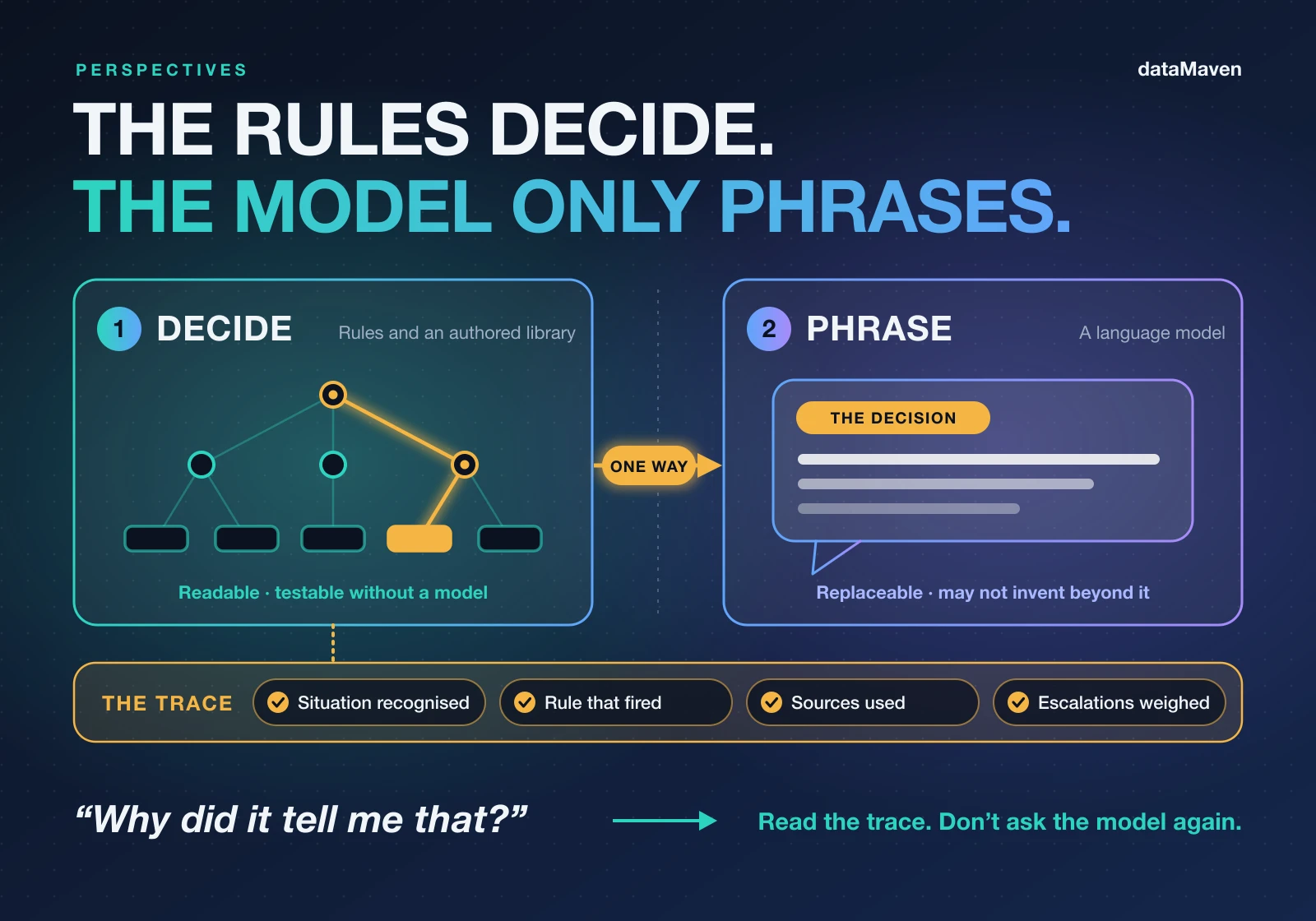
Sooner or later, a customer of any AI product asks the same question.
In the product I have been building this year, the sharp version of that question is easy to imagine. The system prepares a manager for a difficult conversation with someone on their team. Most of the time it suggests how to open, what to listen for, what to avoid. Occasionally it says: stop, this one is not yours to handle alone, bring in HR.
The first time that happens to a customer, they will want to know why. And “the model thought so” is not an answer anyone can act on, defend, or correct.
So we made a decision early that shaped everything after it.
The model does not decide what to recommend. It only phrases it.
The default build
The obvious way to build this kind of product takes an afternoon.
Collect the context. Write a long prompt that describes good management practice. Send both to a large language model. Show the manager what comes back.
It demos beautifully. The output is fluent, specific, and sounds like an experienced coach.
It also has three problems that do not show up in a demo.
You cannot say why. The recommendation came out of a prompt and a few billion weights. You can ask the model to explain itself, and it will, fluently. But that explanation is a second generation, not a record of the first.
You cannot hold it still. Change the model version, reword the prompt, add a sentence of context, and the advice shifts. Nobody chose the new advice. It just arrived.
The expertise is not yours. The product is supposed to carry a specific body of knowledge, in this case years of someone’s work on how teams behave. In a prompt-only build, that knowledge is a few paragraphs of instruction competing with everything the model absorbed from the internet. What comes out is the average of management advice, well written.
Two layers, one boundary
The alternative is to split the system in two and be strict about the line between them.
The decision layer is ordinary code and data. It takes the situation, classifies it, and selects what to recommend from a library of authored units. Each unit says, in plain structured text: under these conditions, this is what is going on, this is the risk, and this is the intervention. The selection logic is rules. You can read it. You can step through it in a debugger.
The expression layer is the model. It receives the decision that was already made and turns it into something a busy manager can read in thirty seconds, in the right tone, using the specifics of their situation. Its instructions are explicit: your job is expression, not decision-making, and you may not invent beyond what you were handed.
The model is very good at the second job. It was never the right tool for the first.
What the boundary buys you
An answer to “why did it say that?” Every recommendation stores a trace: which situation the system recognised, which rule fired, which sources of context contributed and which stayed silent, and whether anything escalated the case. We record this even when nothing unusual happened. If you only keep traces for the dramatic cases, the ordinary ones look unexamined.
Experts can author the product. The library is structured text, not code and not prompt folklore. The person whose knowledge the product carries can read a unit, disagree with it, and change it. That is impossible when the knowledge lives inside a prompt that only one engineer dares to touch.
The whole system is testable without a model. We run a stand-in that returns labelled placeholder text instead of calling a real model. Every decision path can run in tests, deterministically, with no model call and no bill. A change in what the system recommends shows up as a change to a rule or a library file, where a person can review it.
The model becomes replaceable. Because the model only phrases, swapping one vendor for another, or for a model running on your own hardware, changes the wording and nothing else. The advice does not move. For anyone who has read a model deprecation notice this year, that is not a small thing.
Failure is honest. When no authored unit fits the situation, the decision layer says so. It does not improvise. An explicit “we do not have a good answer for this yet” is a gap you can see and fill. A fluent improvisation is a gap you will find out about from a customer.
Where the model still judges
It would be dishonest to say the model never exercises judgment.
Managers write free-text notes, and somebody has to work out what a note is about. Rules catch the clear cases. For the unclear ones, we do ask a model for a classification.
The difference is that we label it. A judgment that came from a model is recorded as such and kept apart from a confident rule match. The boundary is not “no model anywhere near a decision”. It is “every place the model touches a decision is named, narrow, and recorded”.
What it costs
This is not free, and the costs are worth stating.
Someone has to write the rules. The library is real authoring work by a real expert. There is no shortcut, and the product is only as good as that content.
Coverage is finite. A model will say something about anything. A rule library covers what has been written and nothing else. You will ship with gaps, and you have to be comfortable showing them.
The demo is less magical. The first prototype of the prompt-only version will look more impressive than the first prototype of this one. That gap closes quickly, and then reverses, but you have to get through the early weeks.
Where this does not apply
Not everything is a decision.
If the job is to summarise a document, draft an email, or search a knowledge base, let the model do it. There is no single right answer to protect and no expert rulebook to encode.
The split matters when three things are true: the output tells someone what to do, being wrong has a cost, and somebody will eventually ask you to justify it. That describes most of what regulated companies want from AI: triage, eligibility, prioritisation, escalation, next-best-action.
The same lesson, again
I keep arriving at this conclusion from different directions.
When we built root-cause analysis for data platforms, we did not use a model to find the cause. We used a dependency graph and a scoring formula short enough to print. When I assess whether an enterprise is ready for AI, the answer is almost never about the model. It is about whether the organisation can state its own definitions and rules clearly enough for any system to follow them.
This is the same point at product scale.
A model is an extraordinary way to say something well. It is a poor place to keep the reasons.
Decide where you can show your work. Then let the model do the talking.